Engineering note · Cold side
Sizing a plunge chiller when the air is 45 °C: three loads and a worked example
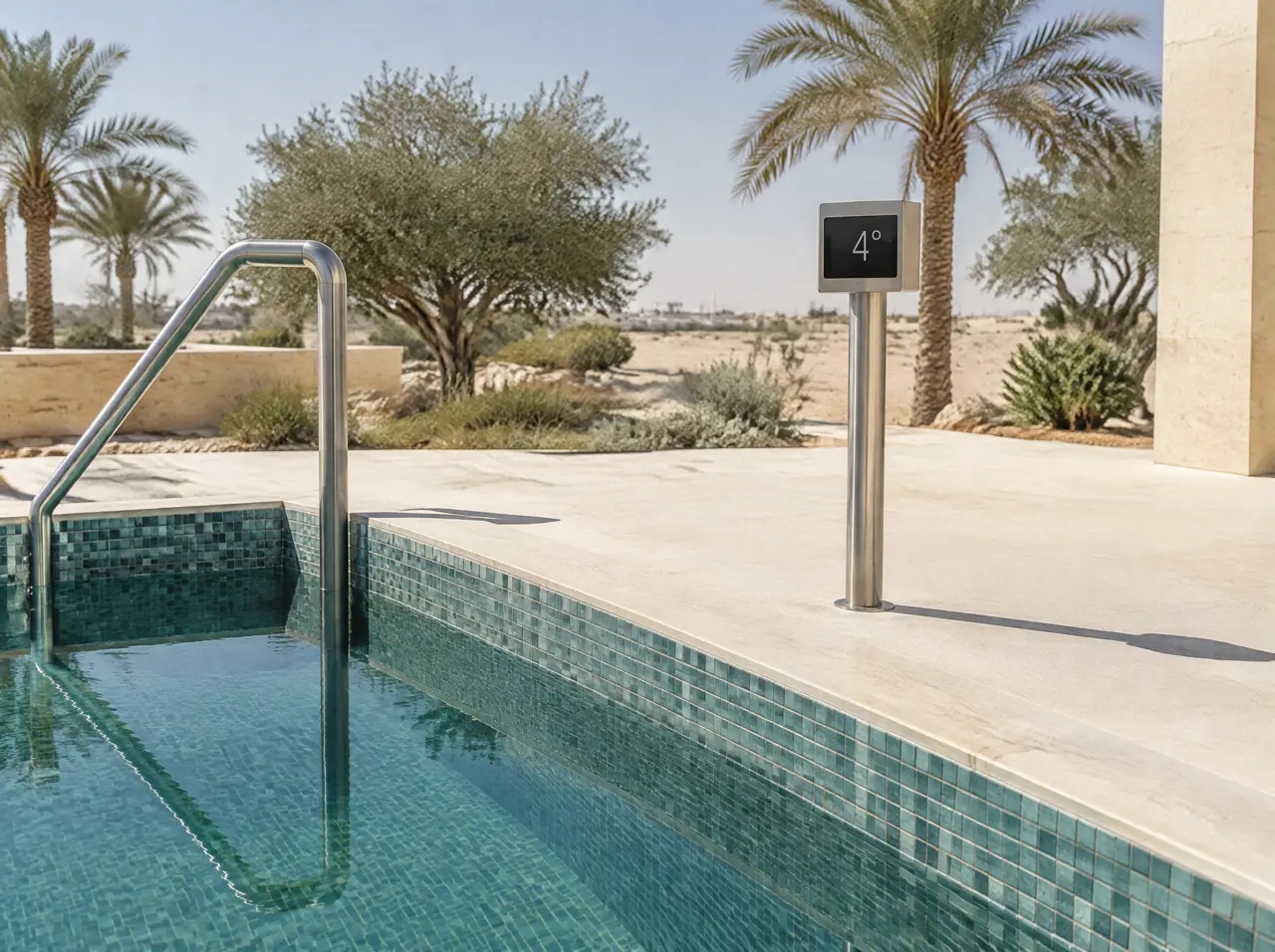
A chiller datasheet describes a mild day. A Gulf terrace in August is not a mild day. These are the three loads that decide whether a plunge holds 4 °C, in arithmetic you can check with a calculator.
Three loads decide whether a cold plunge holds its set point on the hottest afternoon: the heat that must be removed to bring the water down, the heat that leaks in all day, and the capacity the chiller loses when its own air is hot. Not one of them is on the first page of a datasheet. All of them can be estimated on paper.
Load one: bringing the water down
Water holds 4.186 kJ per kilogram per degree. Removing that heat takes energy that no machine can skip, whatever its label says. The figures below are heat to be removed, not electricity used, for a fill at 30 °C brought to 4 °C.
| Volume | Typical use | Heat to remove, 30 → 4 °C |
|---|---|---|
| 250 L | compact free-standing ice bath | 7.6 kWh |
| 520 L | round timber tub | 15.7 kWh |
| 800 L | twin tub | 24.2 kWh |
| 1,100 L | round or square plunge pool | 33.3 kWh |
If a chiller delivers 3 kW of cooling in those conditions, a 1,100 L pool takes about 11.1 hours to pull down; at 6 kW, about 5.5 hours. That is why a first fill is an overnight job, and why a hotel schedules pre-cooling before its opening day rather than on it.
Load two: what leaks in, all day
Once the pool is cold, heat arrives from three directions. The ranges below use stated assumptions and are orders of magnitude, not guarantees.
- Through the shell. A round 1,100 L pool has about 5 m² of wall and floor. At an insulation U-value of 0.4 W/m²K and 26 K between the soil or slab and the water, that is roughly 50 W. In an exposed free-standing tub in 45 °C air, about 4 m² at 0.5 W/m²K over 41 K gives about 80 W. The shell matters, and it is the smallest of the three.
- Through the water surface, from the air. A 1.5 m² surface exchanging heat with 45 °C air at 5 to 10 W/m²K moves roughly 300 to 600 W, and more when the air is humid and moisture condenses on the cold surface.
- From the sun. Midday sun can deliver close to 1 kW to every square metre; a surface absorbing 70 to 80% of that on 1.5 m² takes in about 1 kW or more.
A bare pool in full sun therefore sees something like 1.5 to 2 kW of continuous heat gain, twenty times the shell loss. A pool with a shade structure and an insulated lid whose surface sees neither sun nor moving air drops to a few hundred watts. The cheapest kilowatt you will ever remove is the one you never let in.
Load three: the machine gives less than its label
A chiller's capacity is quoted at a standard rating point. The Eurovent Certita programme for liquid-chilling packages, which follows EN 14511, rates a chiller in cooling mode with outdoor air at 35 °C and water entering at 12 °C and leaving at 7 °C (Eurovent Certita, TCR ECP-3 LCPHP, Rev 01-2026). For Gulf conditions its Desert Certification adds a rating at 46 °C and an operability test at 52 °C. A plunge chiller on a terrace at 45 °C is therefore a long way beyond the point at which its headline capacity was measured: it delivers less cooling and draws more power, by an amount only the manufacturer's capacity table at the higher ambient can tell you, and we ask for that table. As an illustration of the direction, one air-cooled chiller range made for the Middle East quotes an energy-efficiency ratio of up to 3.5 at standard conditions and up to 2.7 at 46 °C (Daikin Applied, EWAD-MZ catalogue), roughly a quarter lower.
A pool in the shade, a pool in the sun
| A: courtyard pool, shaded, insulated lid | B: pool in direct sun, no cover | |
|---|---|---|
| Volume | 1,100 L | 1,100 L |
| Steady gain (order of magnitude) | 0.3 to 0.5 kW | 1.5 to 2.1 kW |
| First pull-down from 30 °C | 33.3 kWh of heat | 33.3 kWh of heat |
| What the chiller must do | overnight pull-down, then idle in short cycles | work continuously on the hottest afternoon |
| Machine class | the nominal table's 4 HP is comfortable | much larger, or two in parallel; the layout says which |
The two pools have the same water and the same finish. The difference is a pergola and a lid. That is the first thing we change in a layout when a client asks for a bigger chiller.
Our nominal table, and the margin we add
The suite builder and the price guide use a nominal table: a 1 HP chiller for up to 260 L, 2 HP for up to 570 L and 4 HP for up to 1,200 L. That table is the minimum for a shaded, covered installation. For an exposed or busy site the project engineer applies a margin (the next machine up, or a second 4 HP machine in parallel above 1,200 L) and says so in the layout. A commercial pool can take two chillers, so one can be serviced while the other runs.
The machines are described under chillers for heat; the pool they serve is on the built-in cold plunge pools page, and a pool with a warm side beside it is a hot and cold pair.
Where the machine stands
- In shade all day, with the air path unobstructed on the intake and the exhaust.
- Away from its own exhaust. A niche where hot air recirculates lets a chiller stall on its own exhaust.
- With a filter on the intake, cleaned on a schedule, because dust blocks a condenser coil as surely as heat does.
- With a coated coil and stainless fittings on a coastal site, where salt does the damage that sand does inland.
- With room to be serviced, and a door that opens onto a service route, not onto the pool.
Running cost, in kilowatt-hours
Running cost is kilowatt-hours times the tariff. The Saudi electricity regulator's service guide, as reported by Okaz in June 2025, lists residential tariffs of 18 to 30 halalas per kWh and commercial tariffs of 22 to 32 halalas. Bahrain's tariff in force since 1 January 2026 charges non-domestic users 22 fils per kWh up to 5,000 kWh a month and 32 fils above, with VAT included and a fixed fee of BHD 1 a month per account (Official Gazette No. 3853, Resolution No. 2 of 2025). For Qatar, Kuwait and Oman we ask the utility for the rate on your meter. As an illustration at the Saudi figures, a 2 HP chiller drawing about 1.8 kW for 12 hours of compressor running a day uses about 21.6 kWh, which costs SAR 3.9 to 6.5 a day at residential rates and SAR 4.8 to 6.9 at commercial rates; a 4 HP machine at 3.6 kW doubles those figures.
Can I just buy a bigger chiller for a pool in the sun?
You can, and it will run harder and cost more to run than a smaller chiller on a shaded, covered pool. Shade and a lid come first; the machine is sized for what is left.
Why not use ice?
Ice cannot hold a set point in Gulf heat, and a regular supply of it is a logistics problem. See free-standing ice baths.
Do you use one chiller for two pools?
Not normally. One chiller per cold pool keeps the circuits separate and lets one pool stay in use while the other is serviced.
More from the journal
Further notes from the plant room
Outdoor suite at 45 °C
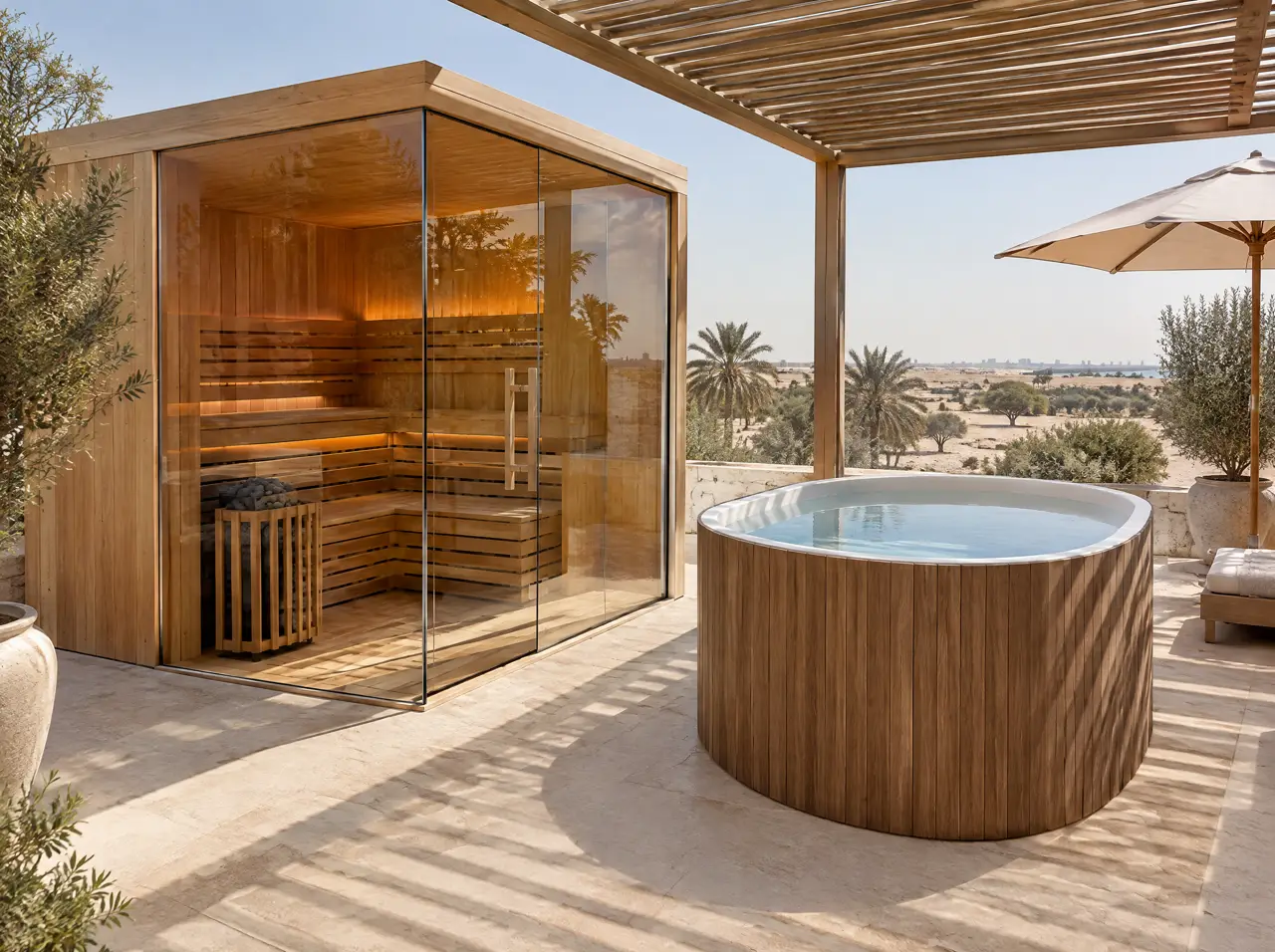
Two seasons, two jobs: what sun does to timber, glass and water, and how to use a terrace suite all year.
Open the page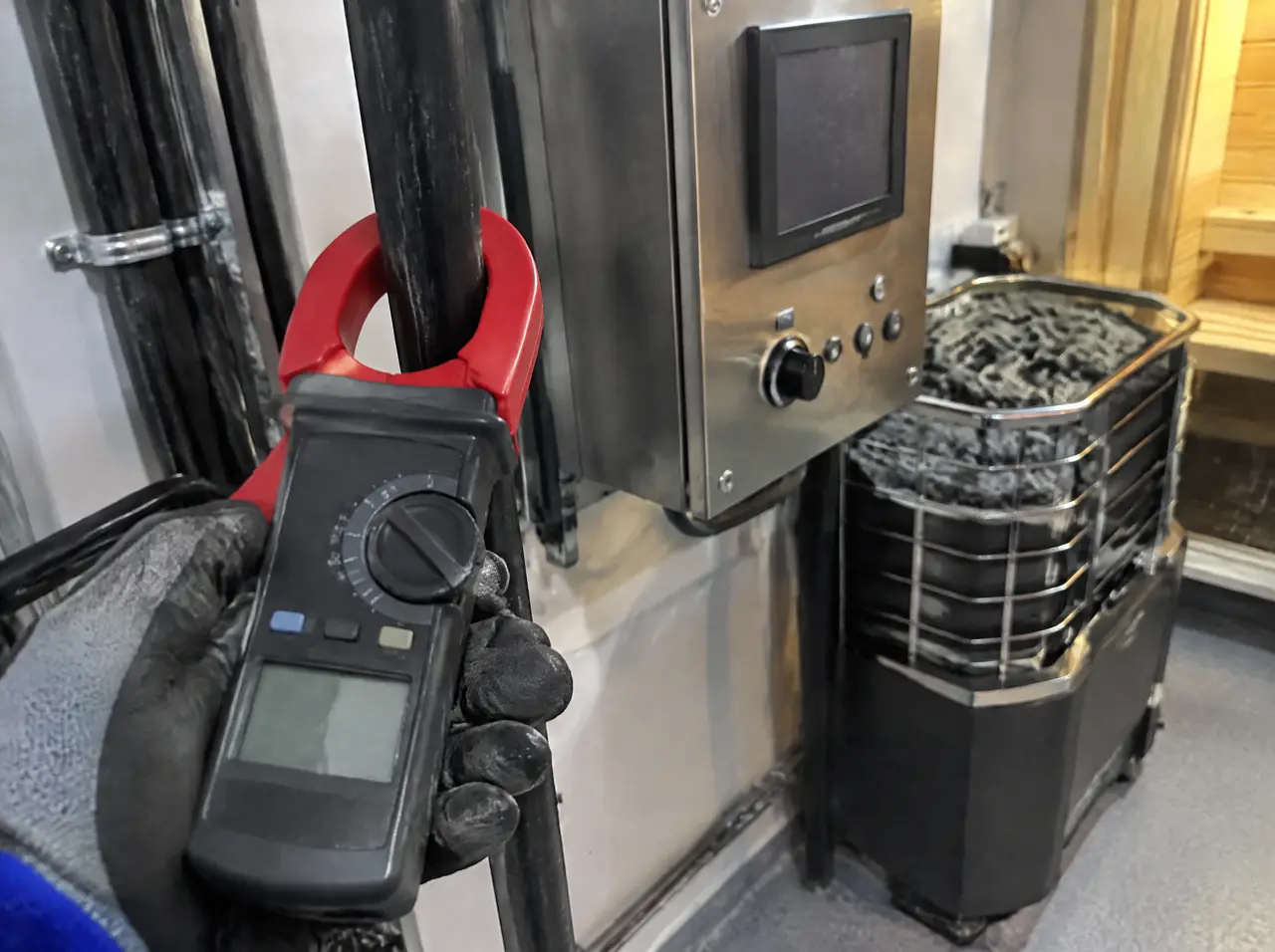
Heaters and chillers on 60 Hz
Which loads care about frequency, why a pump on the wrong supply runs a fifth faster, and what to put in the specification.
Open the page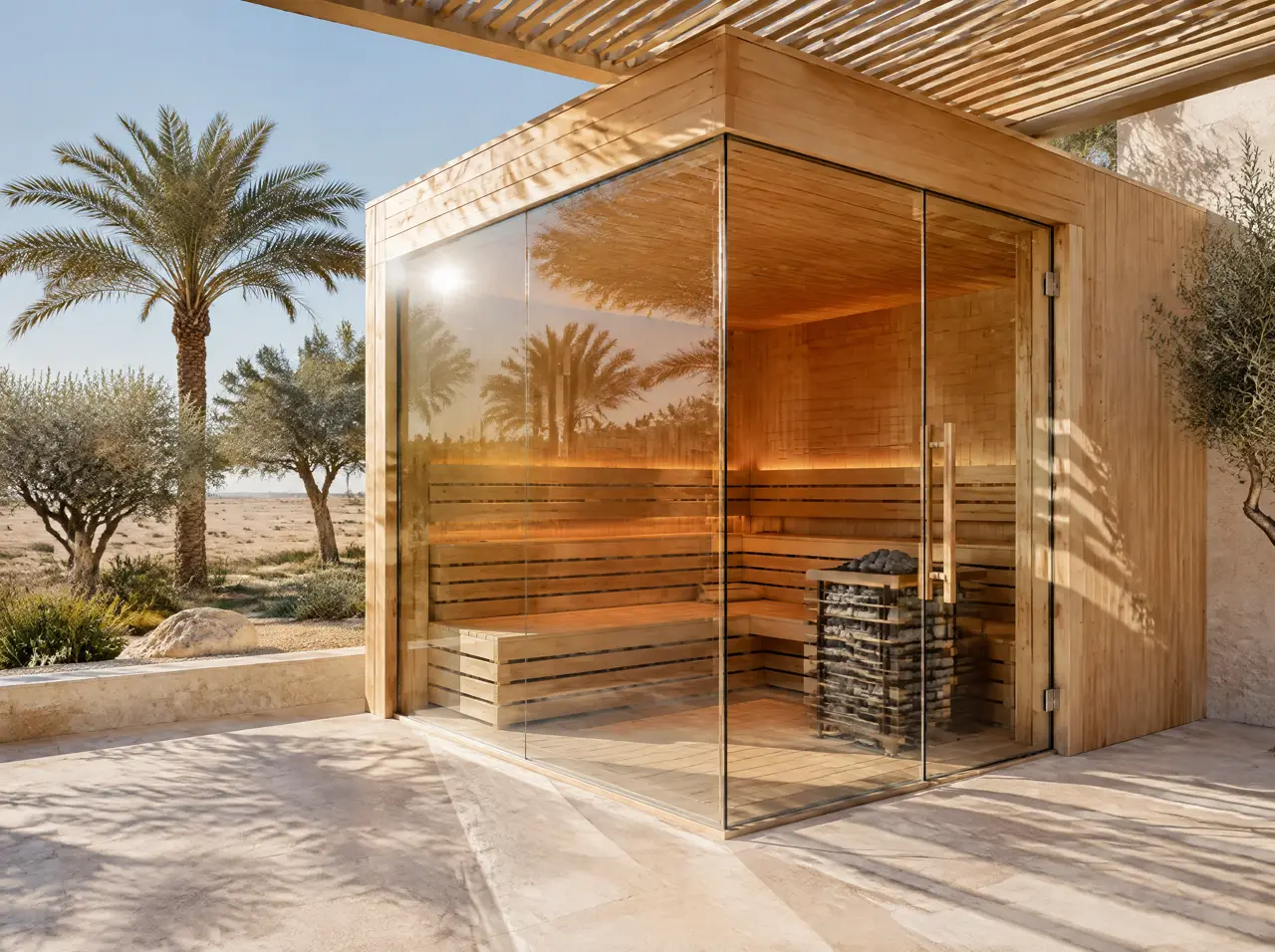
Glass saunas in desert heat
Toughened glass, heat loss in kilowatts, sun and thermal stress, and what the air-conditioning engineer needs to know.
Open the pageFrom the note to your site
Send the site and the pool size: we run the sums with your sun, not an average one
One message starts the layout
Send a plan or three photographs of the space and say who will use it. The project desk answers with questions first, then a 3D layout and an indicative range.
Message on WhatsAppBuild the suite first