Operations note · Water
Keeping a commercial plunge clean: filter, sanitiser, a second line and a log
A plunge holds about 1,100 L and is shared by everyone who uses the club or the spa that day. This note sets out the treatment train in order, the WHO guideline values and their limits, and the questions that belong with the health authority.
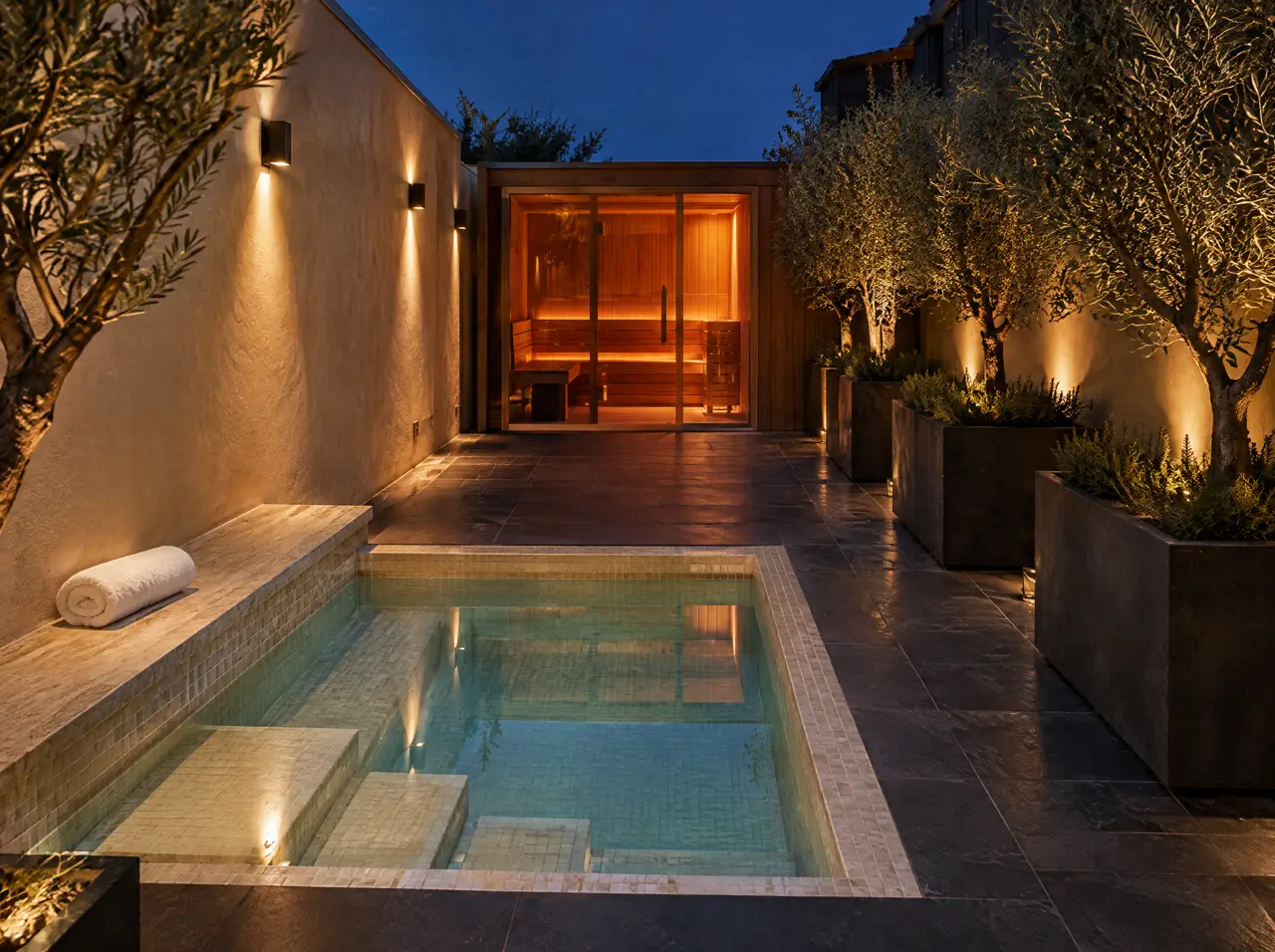
A plunge pool is small, cold and shared. That makes it simple to build and unforgiving to neglect: 1,100 L is a fraction of a swimming pool, so each bather is a larger share of the water. Treatment is a circuit that runs all day plus a routine that people carry out, and the equipment is the smaller half of the two.
The treatment train, in the order the water meets it
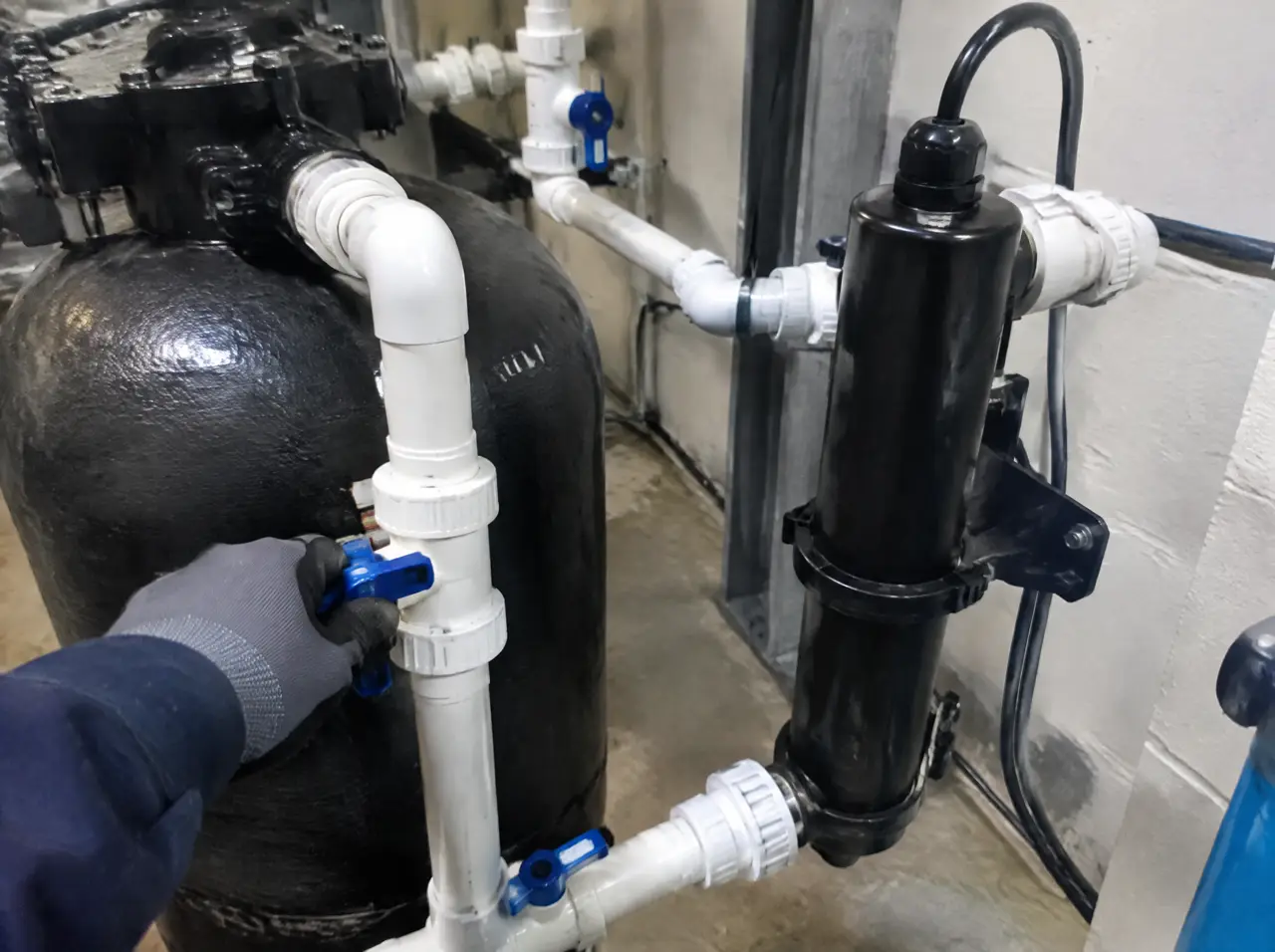
- Circulation pump. Moves the pool's water through the plant continuously. If the water is not moving, nothing downstream is working.
- Filter. Takes out particles. Its pressure gauge is the operator's early warning: a rise from the clean-filter reading says the filter needs rinsing.
- Sanitiser. Chlorine or bromine keeps a residual in the water, so it is still working after the water has left the plant. The layout names the product once the authority has answered.
- A second line: UV or ozone. Fitted on commercial pools, both treat the water as it passes and neither leaves a residual: they add to the sanitiser and do not replace it.
- Display and controls. A small display at the rim shows the temperature; the plant shows pressure and alarms; the operator's log records them.
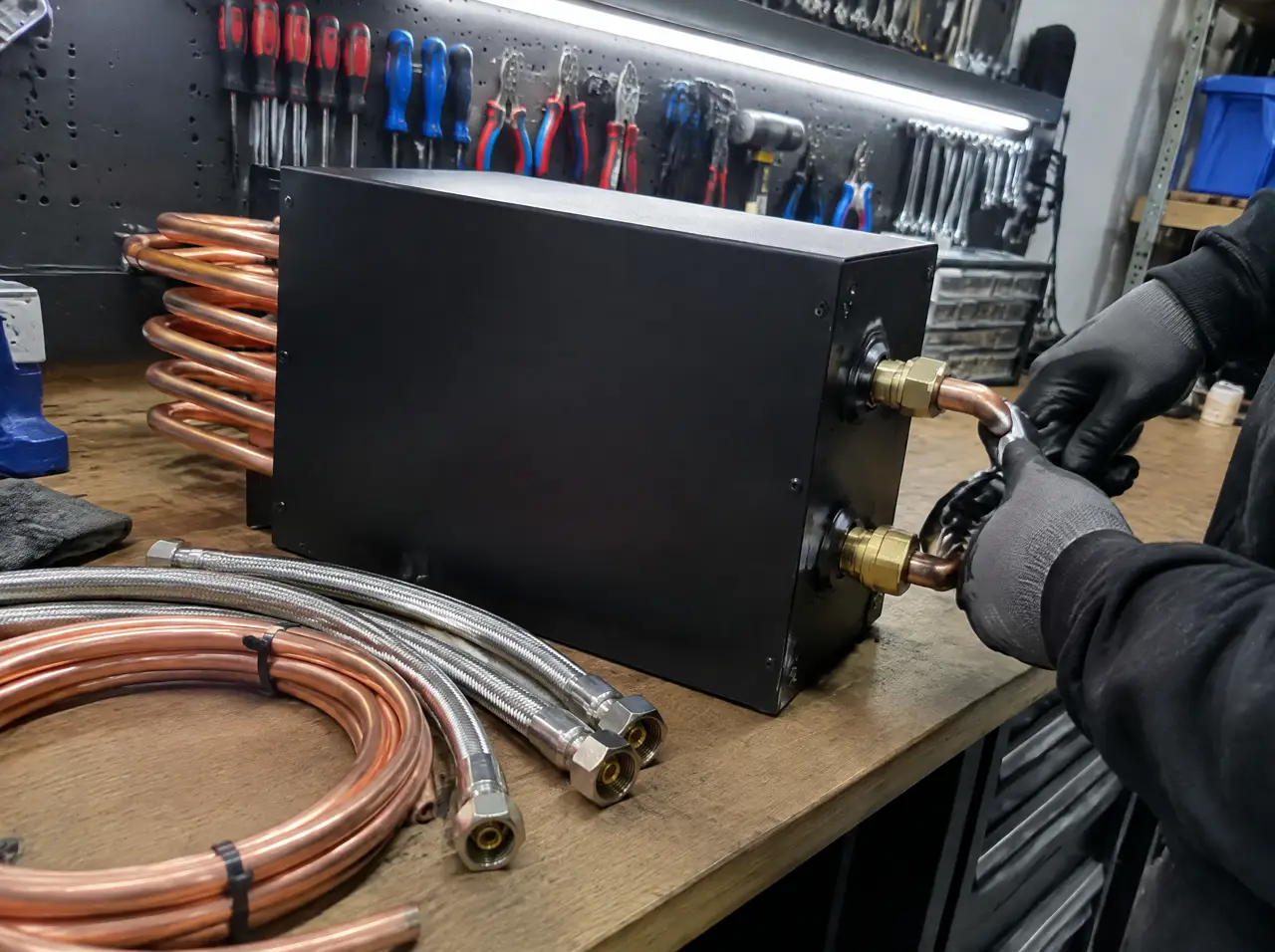
The chiller stands on the same plant and cools the same water. A warm pool in a hot and cold pair runs on its own circuit and filter and needs closer attention to its sanitiser than the cold one, so it has its own line in the log.
What the WHO pool guidelines say, and why the authority decides
The World Health Organization's Guidelines for Safe Recreational Water Environments, Volume 2: Swimming Pools and Similar Environments (2006) give these values:
| Quantity | WHO guideline value, 2006 |
|---|---|
| Free chlorine in a conventional pool | 1 mg/L is adequate |
| Free chlorine when combined with ozone or UV | 0.5 mg/L or less |
| Free chlorine, upper limit in public pools | 3 mg/L |
| pH when chlorine is used | 7.2–7.8 |
| Ozone and UV on their own | No residual disinfectant; they must be combined with chlorine or bromine |
These are guideline values for swimming pools and similar environments, written in 2006. Whether a 1,100 L plunge at 3–5 °C is treated as a swimming pool, a spa pool or something else, and which numbers it must meet, is for your local health authority to say. Where its rules differ from the table, its rules win and the plant is set to them. We quote the table for its shape, not as a rule for your pool.
Eight questions to put to the health authority
- Is a cold plunge pool classed as a swimming pool, a spa pool or another type, for licensing and inspection?
- Which sanitisers are accepted, and is UV or ozone accepted as a second line?
- What free chlorine and pH ranges must be kept, and how often must they be measured and recorded?
- Is there a turnover requirement, meaning how often the whole volume must pass the filter?
- Are there bather limits, shower-before-entry rules or signs it expects on the wall?
- Must a trained or certified person run the water, and who may supply and handle the chemicals?
- Are laboratory samples required, how often, and where are the results kept?
- Where may filter rinse water and emptied pool water be discharged?
Litres per bather: why a busy plunge is read at the peak
Because the volume is small, a few extra bathers change the water faster than they would in a large pool. Divide the plunge's 1,100 L by the bathers it sees:
| Load on one plunge | Litres of water per bather |
|---|---|
| 8 bathers in one hour | 138 L |
| 16 bathers in one hour (four padel courts finishing together) | 69 L |
| 50 bathers in a day | 22 L |
| 100 bathers in a day | 11 L |
These numbers say nothing about what is safe; only the authority and the water engineer can say that. They show that a busy plunge needs readings at the peak as well as at opening, and that every rule which keeps dirt out of the water, a shower first above all, counts for more here than in a large pool.
The log sheet and the routine behind it
The same sheet serves a hotel, a padel or fitness club and a clinic; what changes is who signs it. Keep one per pool.
| Reading | Date and time | Water °C | Free chlorine mg/L | pH | Filter pressure | Initials |
|---|---|---|---|---|---|---|
| Limit or target | 3–5 °C set point | set by the authority | set by the authority | clean-filter reading | ||
| Before opening | ||||||
| After the peak | ||||||
| At closing |
| When | What is done |
|---|---|
| Each opening | Read temperature, free chlorine, pH and filter pressure and write them down; check clarity and the display; wipe benches, rails and steps; take the lid off |
| After the peak | Repeat the readings; correct anything outside the range; note what was done |
| Weekly | Rinse the filter on the schedule in the care sheet; clean the waterline and steps; clear the chiller's intake filter; check that test reagents are in date |
| Monthly | Check the UV lamp's hours or the ozone unit against the maker's schedule; check chemical stock and dosing; review the month's log with the engineer |
| Each service visit | Inspect the chiller coil, pump seals and filter; sign the service sheet |
Backwash and emptying: questions for the water engineer
We do not set a backwash or emptying frequency here: it depends on the bather load, the filter and the authority's rule. Put these to the engineer in writing.
- Is backwash triggered by time or by a rise in filter pressure, and by how much?
- How often is the pool emptied and refilled, and do the dose or the contact time change for water at 3–5 °C?
- How many litres go to drain each time: 1,100 L per plunge, 1,300 L for a warm pool, plus the backwash?
- Where does it go, at what rate, and who has agreed that discharge point?
- How long does a refilled plunge take to return to 3–5 °C, and what does the club or hotel do meanwhile?
For the drain, do the sum: three plunges emptied together are 3 × 1,100 L = 3.3 m³ before any backwash. A refill is an overnight job for the chiller, as chiller sizing at 45 °C shows.
Showers, rules and staff routines
- A shower before entry and a rinse point at the pool edge, with the rule posted and enforced.
- Seated stays, short times, adults only and never alone, with a sign saying that heart and blood-pressure conditions call for a doctor's opinion first.
- Ask the authority which exclusions it wants on the sign, such as illness, open wounds and children.
- Each shift knows who tests, who records and who may close the pool, and the rule for a reading outside the range: close, correct, retest, record, reopen.
- The daily routine is written so that a new member of staff can follow it from the care sheet; the plain displays and the short sheet are there for that.
What the operator keeps in writing
- The daily log and the weekly and monthly sheets, kept where an inspector can ask for them.
- Service records for the filter, the UV lamp or ozone unit and the chiller.
- Chemical stock, dosing records and the safety data sheet for each product.
- Staff training records and the posted rules.
- An incident book and any correspondence with the authority.
- Our commissioning pack: the signed temperature report, the equipment schedule, the care sheet and the warranty terms.
Ask the authority how long each record must be kept; the answer goes on the front of the folder.
Is UV or ozone enough without chlorine?
No. The WHO guidelines (2006) state that ozone and UV leave no residual disinfectant and must be combined with chlorine or bromine. That is why we describe them as a second line on commercial pools, not a replacement.
What does the plant include for water treatment?
Circulation, filtration and sanitising on every pool; on commercial pools UV or ozone is added behind them as a second line; and a small display sits at the rim. The layout lists each item with its power and its place in the plant room, and the log sheet and the care sheet come with the handover.
Who tests the water, our staff or a contractor?
Daily readings are an operator task, because they happen at opening and after the peak. A contractor or a laboratory can add periodic checks if the authority asks for them; ask which it wants. The plant that comes with each pool is described under cold plunge pools.
More from the journal
Further notes from the plant room
Hotel spec sheet
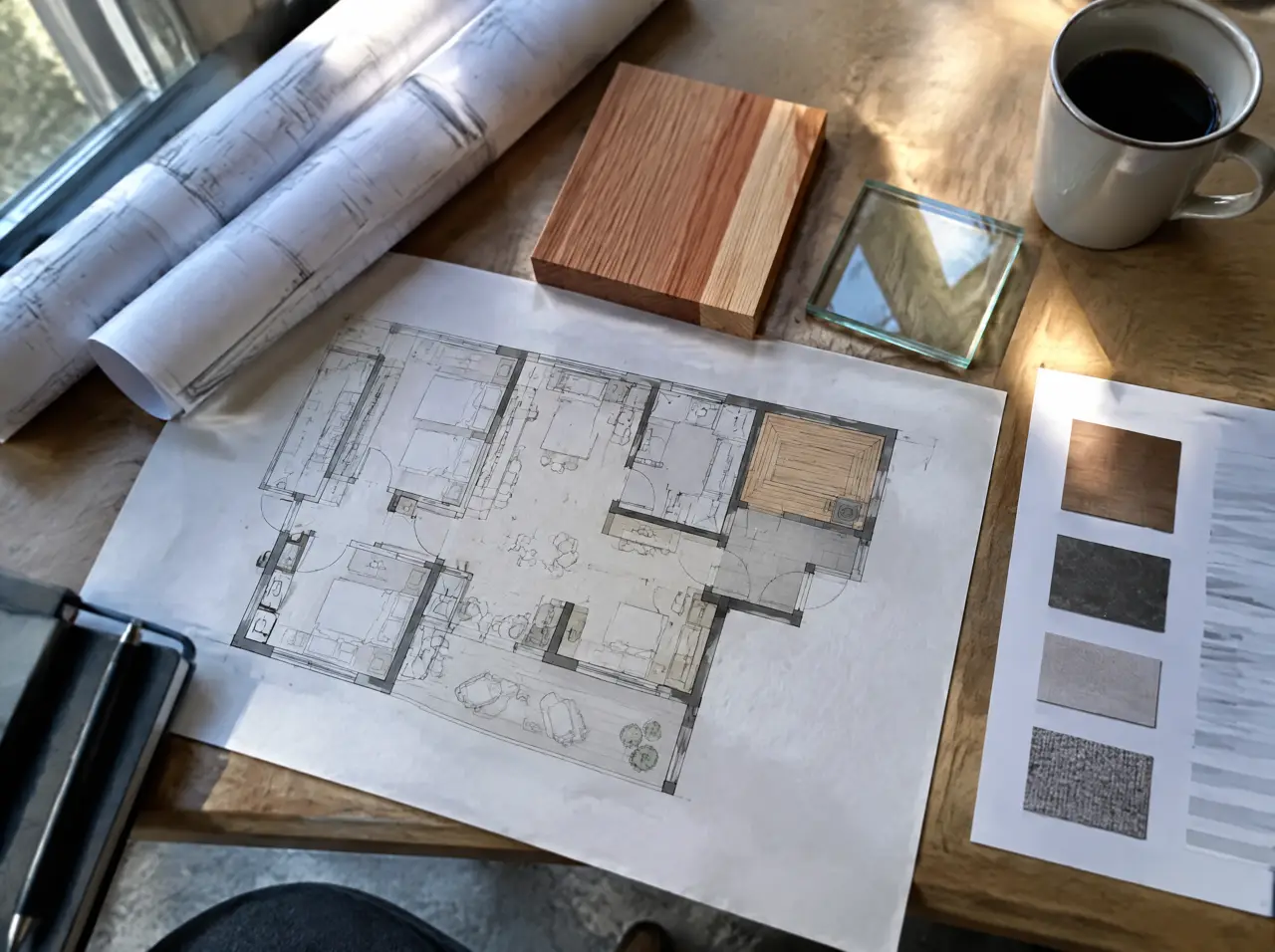
Connected load, water weights, heights, drains, plant air path, clashes and handover for a sample hotel level, written for architects and MEP.
Open the page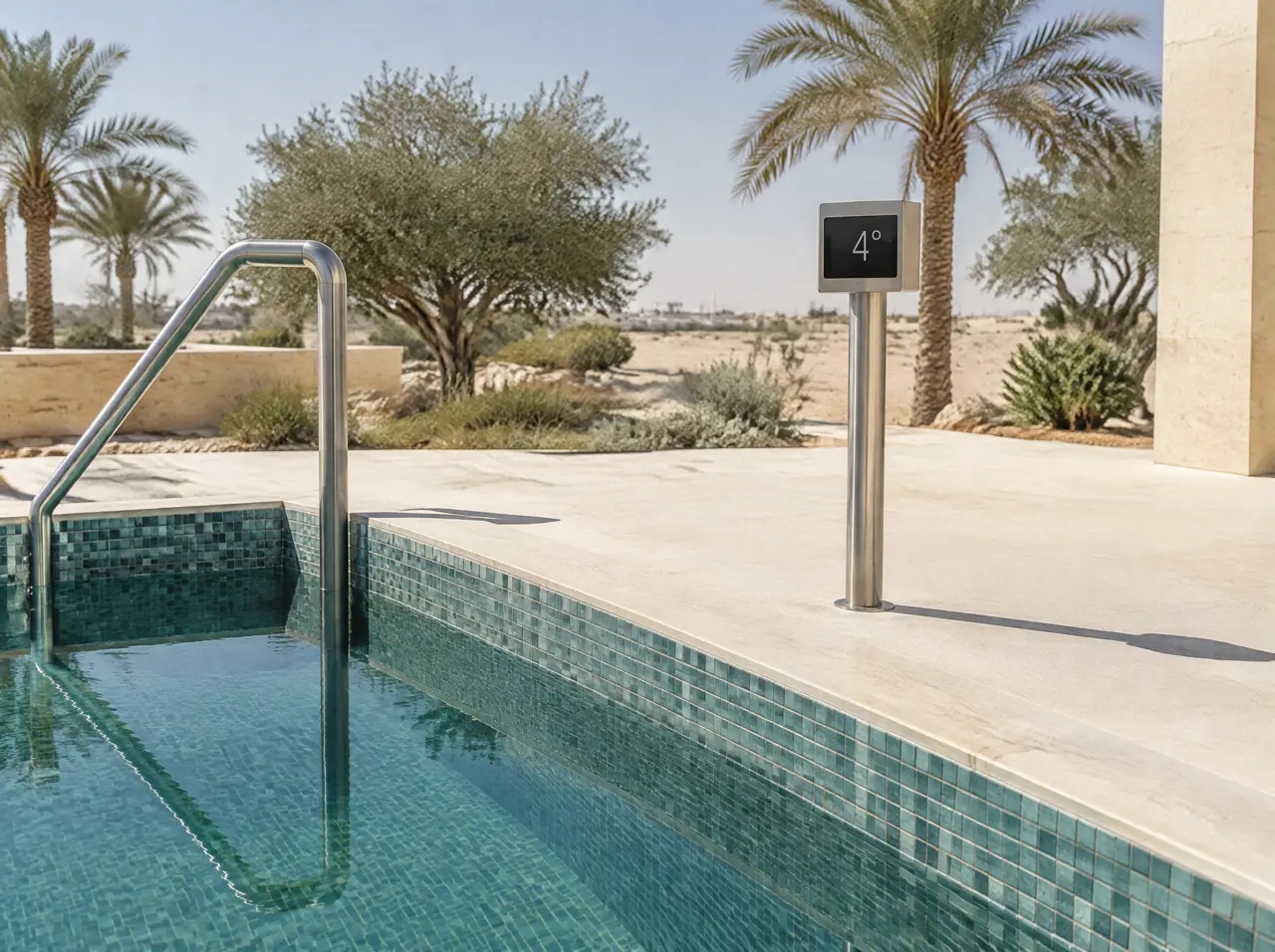
Chiller sizing at 45 °C
Three loads, two worked examples and the reason a plunge in the sun needs a different machine from one in the shade.
Open the page
Ramadan and the season
Three calendars on one page, two worked schedules and the last date to order for a suite you want by Ramadan or by the new season.
Open the pageFrom the note to your site
Send the pool list and the city: we return the plant, a log sheet and the questions for your local authority
One message starts the layout
Send a plan or three photographs of the space and say who will use it. The project desk answers with questions first, then a 3D layout and an indicative range.
Message on WhatsAppBuild the suite first