Buyer's guide · Terms
Sauna, steam room, hammam, infrared: four rooms that buyers order with one word
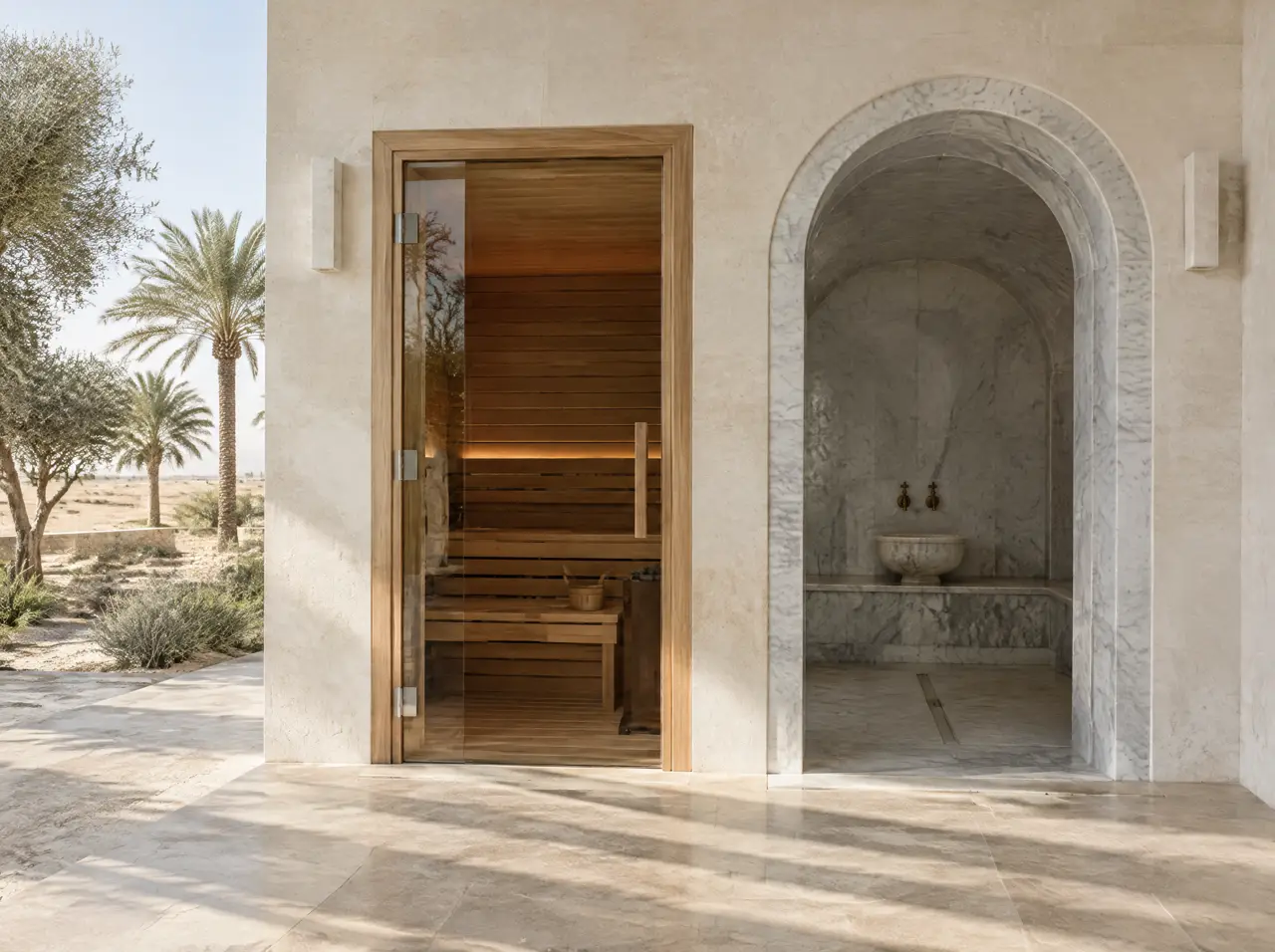
The Arabic search phrase for a steam sauna usually means a steam room, which is a different room from a dry cabin. Here are the four rooms defined plainly, and the lines to put in a brief so that a quote answers the question you asked.
The words overlap because the rooms do. A hotel brief that lists “sauna and steam” as one line, a villa client who asks for a hammam and means any warm tiled room, and a search for a steam sauna all reach a supplier as the word sauna. Four different rooms hide behind it, and each needs its own plant, its own builder and its own kind of building.
Four rooms, four definitions
| Room | What it is | Air | Do we build it? |
|---|---|---|---|
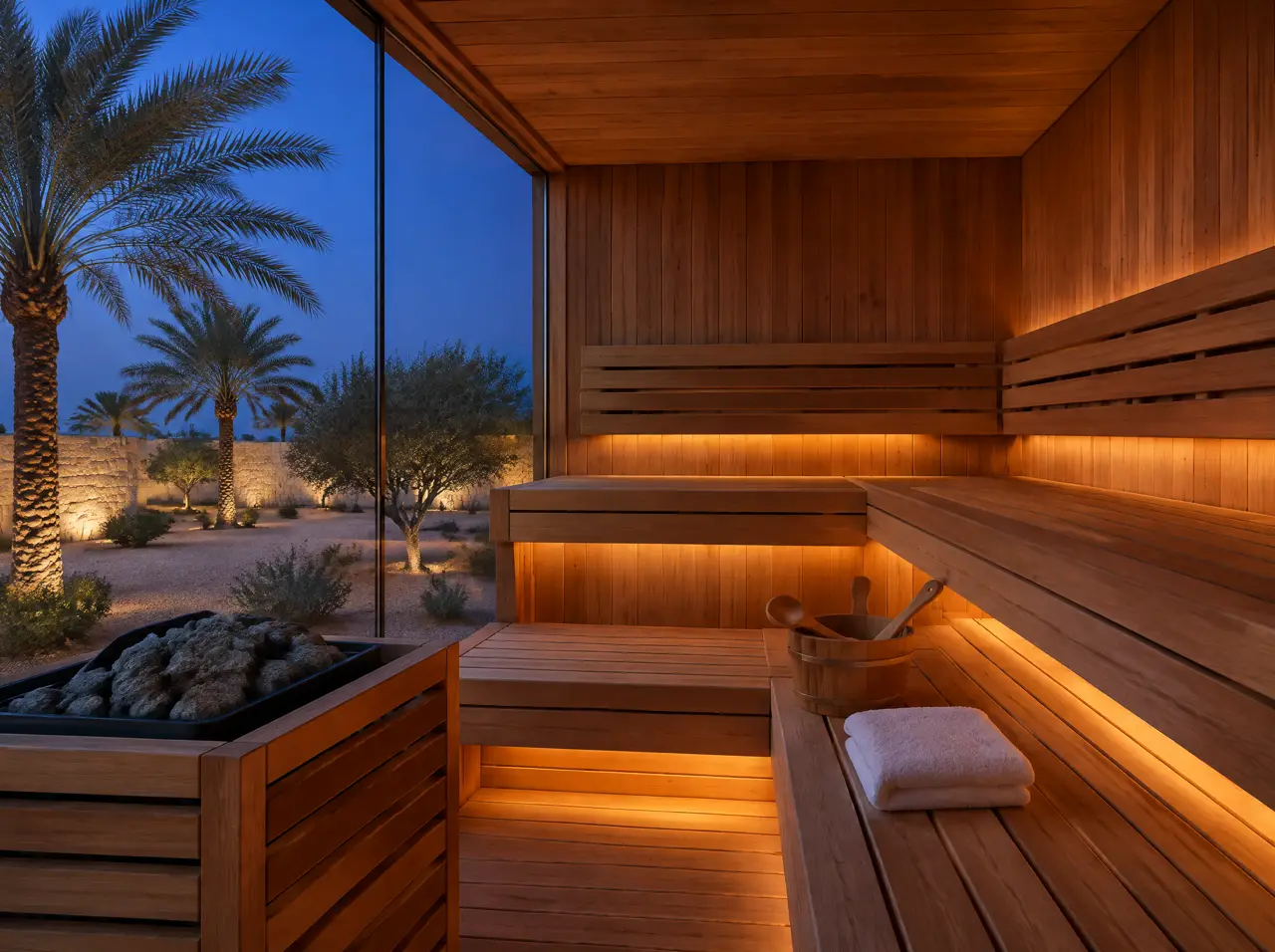
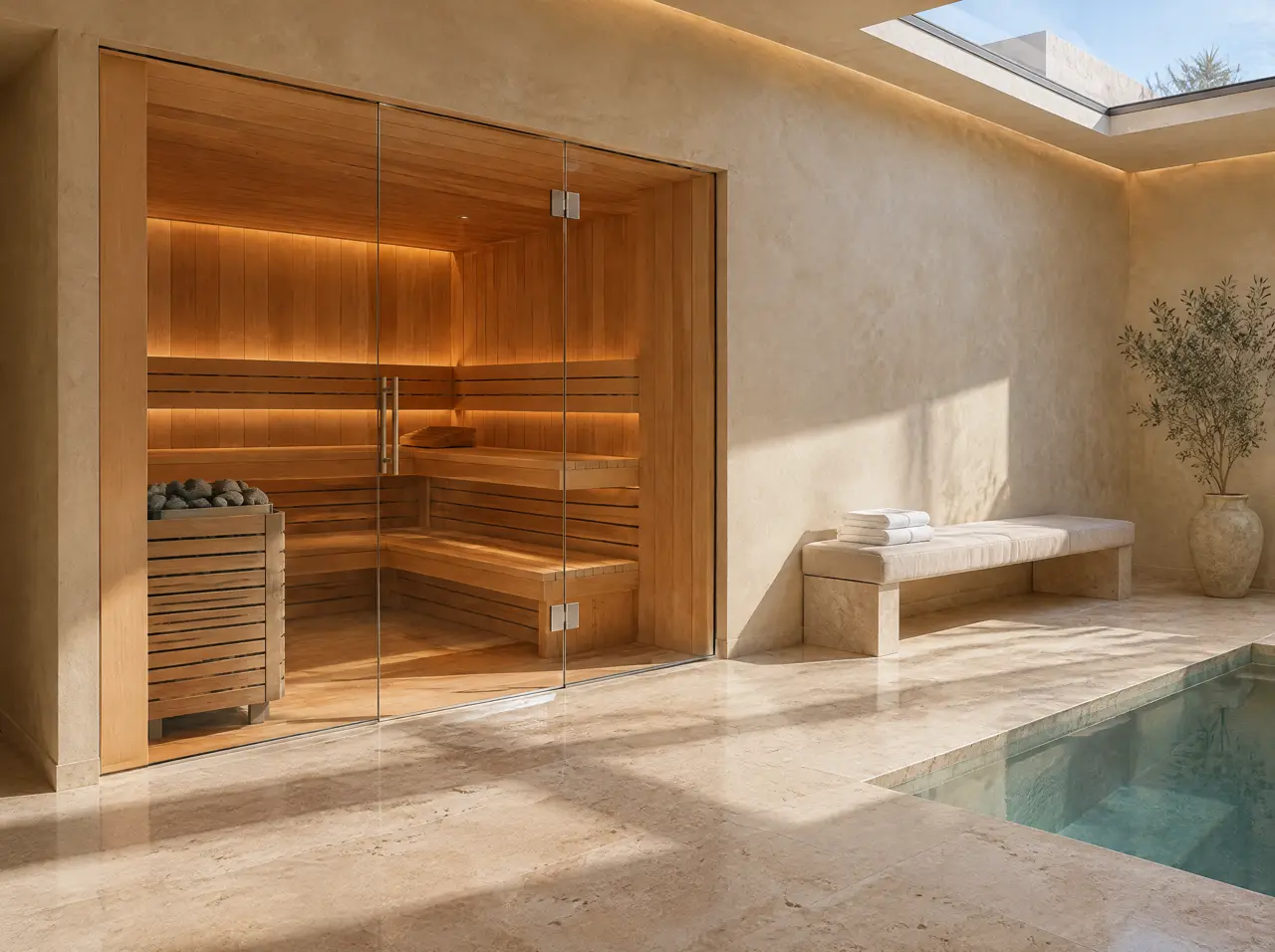
| Dry heater sauna | A timber-lined cabin heated by an electric heater and stones, with air entering low and leaving high | Hot and dry, 90–110 °C; water thrown on the stones gives a short burst of humidity | Yes: glass cabins of 1 to 12 seats |
| Steam room | A sealed, tiled room filled by a steam generator, with a waterproofed envelope and a drain | Saturated with moisture, at a much lower air temperature than a sauna | Yes: tiled hammam steam rooms for 2 to 8 people |
| Hammam | A bathing tradition built around warm, humid, tiled rooms and washing, not just a type of room | Warm and humid, with water for washing | The steam room at its heart, with bench and basin; the washing rooms around it are the architect's |
| Infrared cabin | A cabin warmed by panels that heat the body directly | A lower air temperature than a heater sauna | Panels as an optional addition inside our cabins |
Two cautions on the table. The infrared row is a different product, not a cheaper version of the first: panels warm the body directly and leave the air cooler, so it feels different from heater heat, and the layout explains the difference before you choose. The hammam row is not a size either: a hammam is a bathing tradition, so a brief for a full one is a brief for a washing programme that a spa operator or an architect writes; what we build is the steam room at its heart, with the bench, the basin and the drain.
What the Arabic phrase for steam sauna really orders
In Arabic, ساونا بخار means, word for word, steam sauna. In practice it usually names a steam room, so a buyer who types it is usually asking for the tiled wet room rather than the dry cabin, and a supplier who answers with a dry cabin has answered a different question. When an enquiry arrives with that phrase, our first reply asks which room is wanted, because we build both and they need different buildings. A buyer who wants a dry heater sauna is better served by the plain word ساونا or by غرفة ساونا (sauna room), together with the lines of the brief below.
What each room asks of the building
- Dry heater sauna. Power for a heater from 3.5 kW (1 seat) to 24 kW (12 seats), a vent route with air entering low and leaving high, and a floor drain outside the door. It is a timber cabin standing inside a room.
- Steam room. A waterproofed room with tiled or stone surfaces, a drain, a water supply and a steam generator with its own power. The room itself is the product.
- Hammam. A steam room with a heated bench and basins at its heart, and washing rooms around it that are the architect's; our part is the steam room and its plant.
- Infrared cabin. Power for the panels and a ventilated timber cabin, with no stones and no steam.
For the air-conditioning engineer the difference is plain. A cabin adds heat to the room around it, and the glass-front note works the figures; a steam room adds moisture, which is a dehumidification load. Ask each supplier for the load its room creates, in the units your engineer uses.
Six lines that stop a quote solving the wrong problem
- Set temperature. The air temperature at the upper bench, in °C. For our cabins it is 90–110 °C, and a cabin is ready in about 40 minutes.
- Humidity. Dry air with an occasional splash on the stones, or air held saturated by a generator.
- Surfaces. Timber lining, or tile and stone inside a waterproofed room.
- Drain. A floor drain outside the cabin door, or a drained floor inside the room.
- Ventilation. A cabin that breathes, with air entering low and leaving high, or a sealed room.
- Heat source and load. An electric heater in kW with its supply, a steam generator, or panels in watts.
Dry electric-heater sauna, timber-lined, 90–110 °C at the upper bench, six seats, glass front, vented low and high, floor drain outside the door. No steam generator and no tiled wet room.
Ask every supplier to answer the same six lines in the quote. A line left blank is the misunderstanding, found before the order and not after. In a bill of quantities, list the dry cabin, the steam room and the hammam as separate lines with separate suppliers.
Reading a quote: the words that name the room
| The quote lists | You were quoted |
|---|---|
| A heater in kW, stones, timber benches and a vent route | A dry heater sauna |
| A steam generator, tiling, waterproofing, a steam outlet and a drain | A steam room |
| Panels in watts and a timber cabin, with no stones | An infrared cabin |
| Tiled rooms, basins and a washing area | A hammam, or part of one |
Take the brief line “sauna for six”. One supplier prices a 6-seat heater cabin at $16.5–23.5k (SAR 62–88k); another prices a tiled room with a generator; a third prices panels. The three totals cannot be compared, because they price three different rooms. If a quote lists none of the words above, ask which room it prices.
Which room for which wish
| If you want | Order | Ask for | Our part |
|---|---|---|---|
| Dry, high heat, with the option of a burst of humidity | A dry heater sauna | Seats, heater kW, glass, temperature | We build it |
| Warm, wet air in a tiled room that is easy to wipe | A steam room | Room size, people, generator kW, bench heating | We build it, with the plunge beside it |
| A washing tradition in warm, humid, tiled rooms | A hammam | The steam room from us; the washing rooms from the architect | The steam room, its bench and its plant; the same plunge applies |
| Gentle warmth in a small space at a lower air temperature | Infrared panels | Panel wattage and coverage | Optional panels inside our cabin |
| Cold after heat, whichever heat you chose | A cold plunge | Litres, set point, chiller | We build it |
What we build and what we decline
- We build dry heater saunas with full-height glass, 1 to 12 seats, from $6.2–8.4k (SAR 23–32k) to $32.5–44.5k (SAR 122–167k); cold plunge pools set into the floor, warm and cold pairs, and the chillers behind them; wooden and free-standing tubs for private homes; infrared panels as an optional addition inside a cabin; and, each on its own page, tiled hammam steam rooms, built-in hot tubs with hydromassage, heated timber tubs and inflatable ice baths.
- We decline salt rooms, snow rooms, portable tent saunas and the washing rooms of a full hammam beyond the steam room itself. If your brief is one of these, the first reply says so and we do not quote around it.
The cabins are described under panoramic glass saunas and bespoke dry saunas, the steam room under hammam steam rooms, the cold side under cold plunge pools, and the money in the Gulf cost guide.
Can a dry sauna be turned into a steam room?
No. A dry cabin is lined in timber and vented to breathe; it is built for dry heat. Water thrown on the stones gives a short burst of humidity, and that does not make it a steam room.
Is an infrared cabin a sauna?
It is a different experience. Panels warm the body directly at a lower air temperature, where a heater sauna warms the air. We offer panels as an option inside our cabins; ask for them explicitly and the layout explains the difference.
Do you build the cold plunge next to a steam room or a hammam?
Yes. A plunge and its chiller stand on their own plant, whichever hot room sits beside them. Send the plan and the plant niche is drawn with it; the plunge itself is described under cold plunge pools.
More from the journal
Further notes from the plant room
What a sauna costs in the Gulf
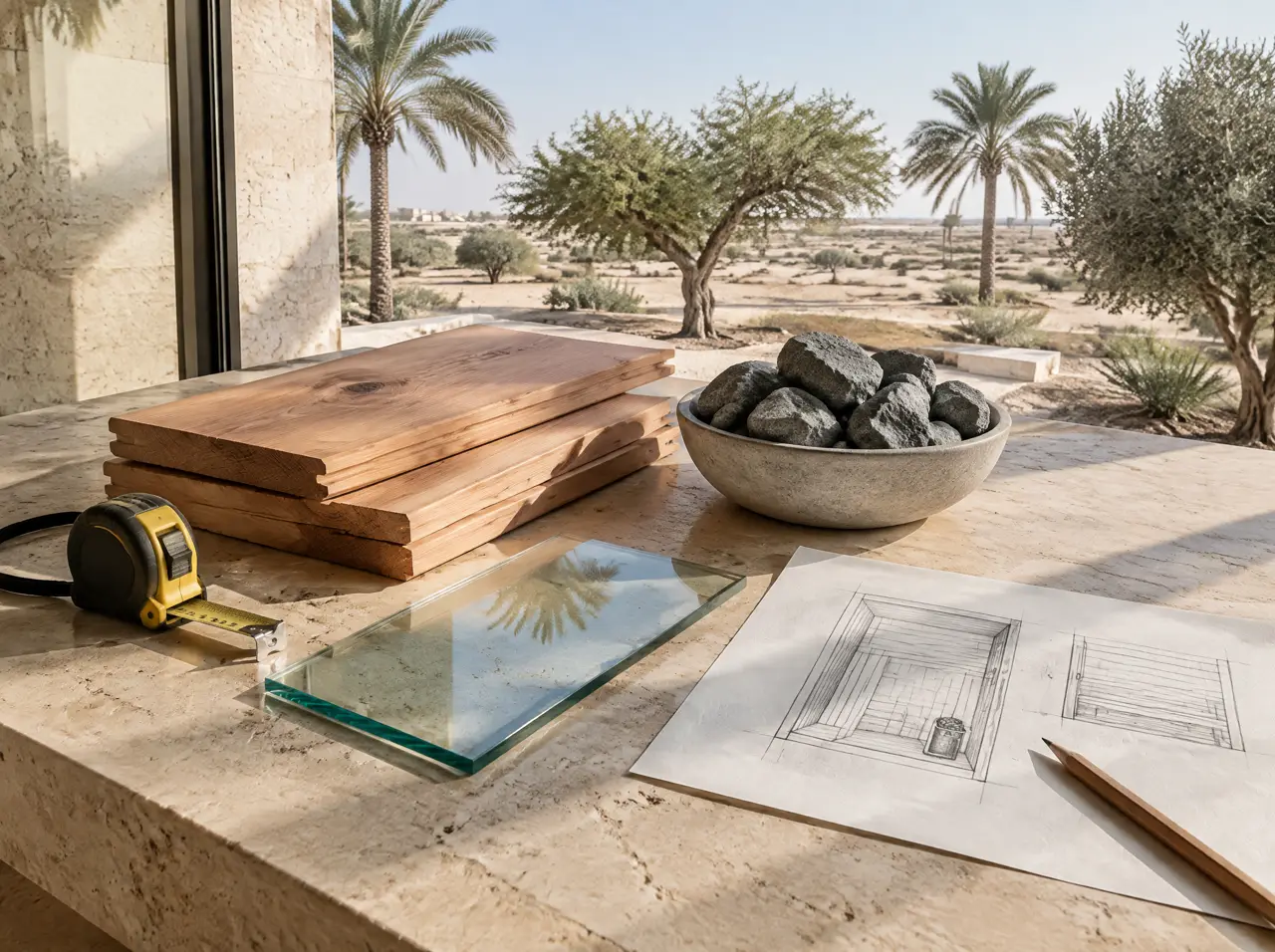
Ranges by seats in USD and SAR, what moves them, three budgets and a checklist for comparing quotes.
Open the page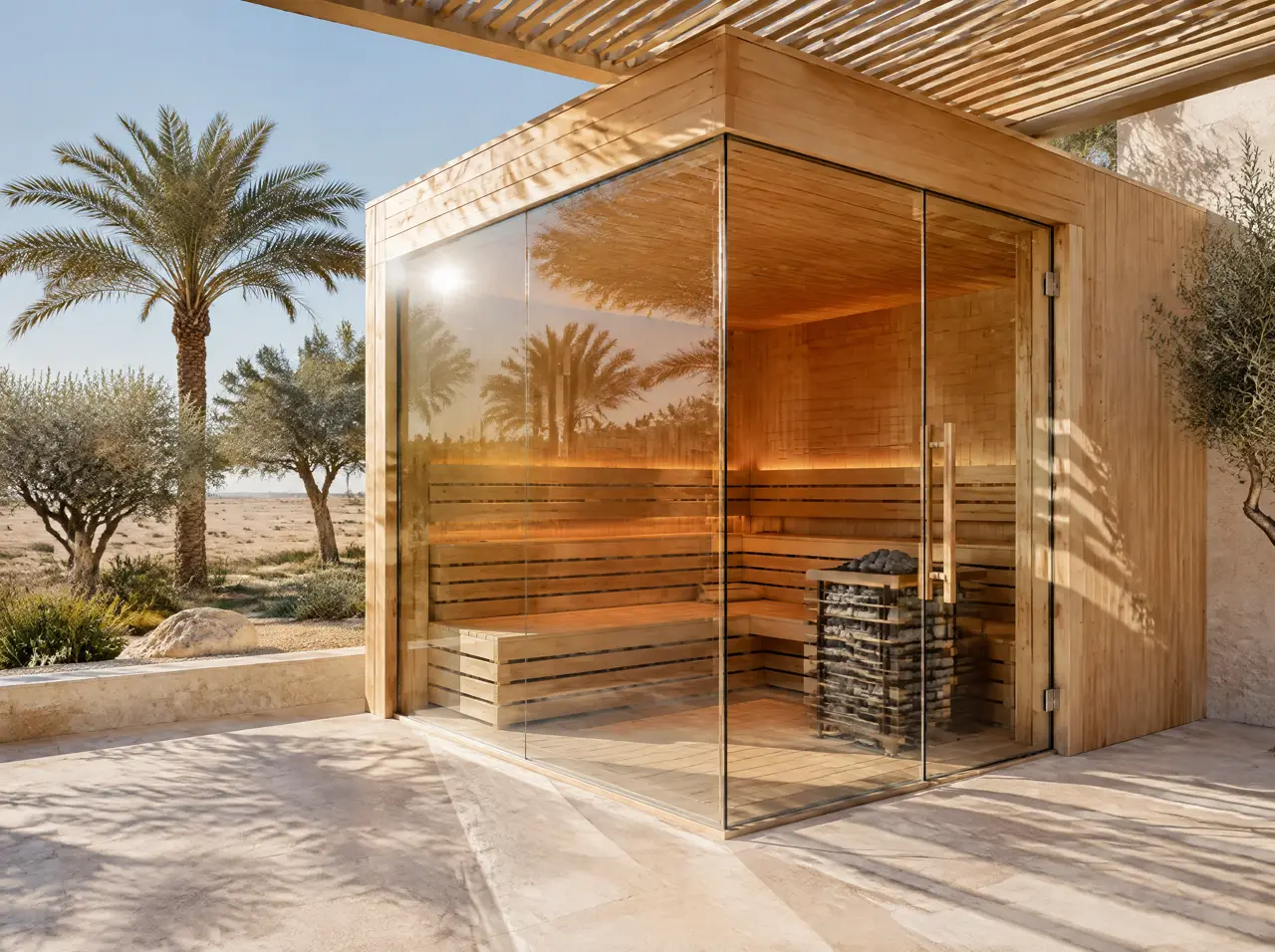
Glass saunas in desert heat
Toughened glass, heat loss in kilowatts, sun and thermal stress, and what the air-conditioning engineer needs to know.
Open the page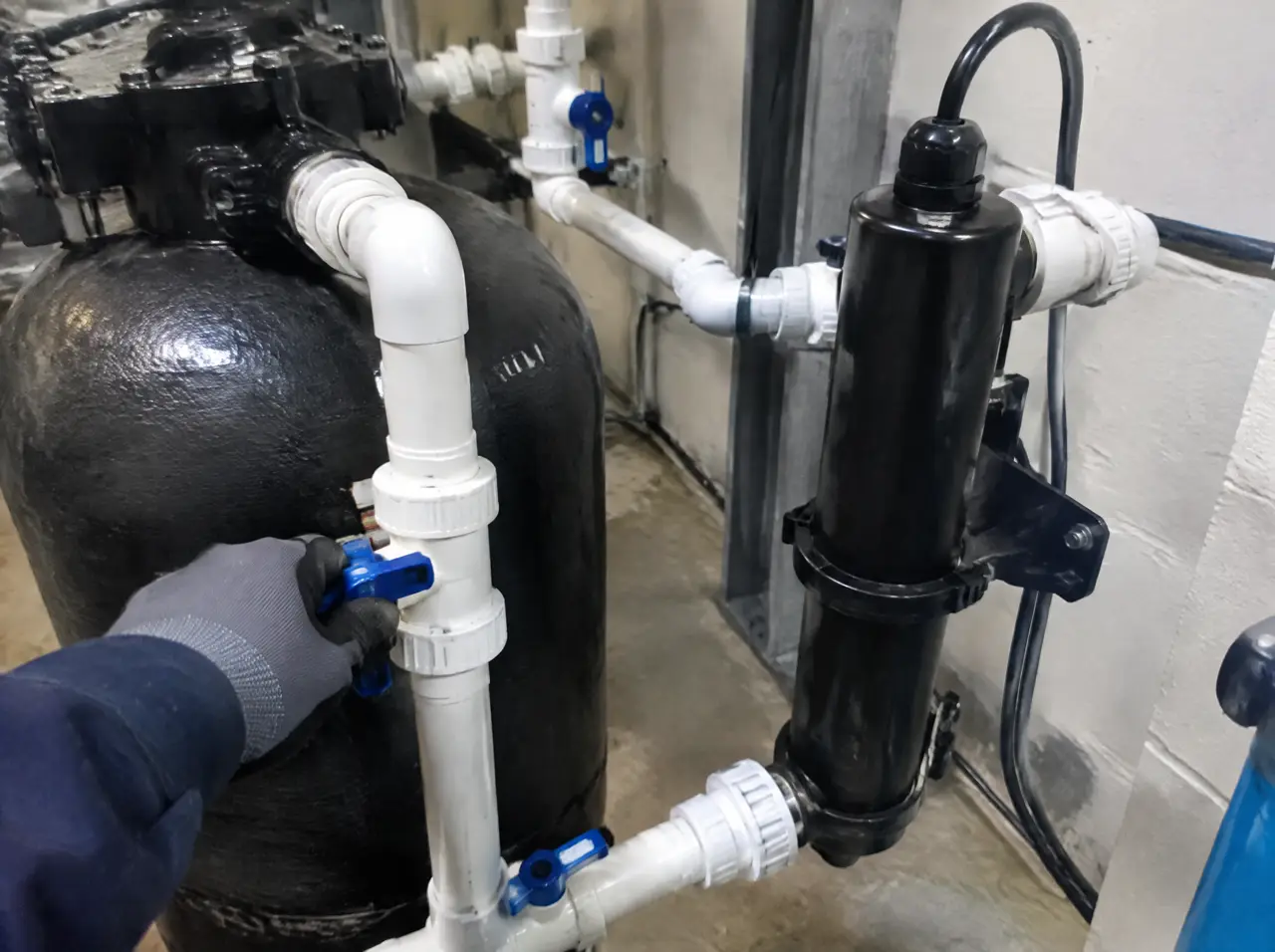
Plunge water treatment
The treatment train in order, the WHO pool values with their limits, a log sheet, bather-load arithmetic and eight questions for the authority.
Open the pageFrom the note to your site
Tell us which of the four rooms you want: if it is one of ours, the layout follows in up to 5 working days
One message starts the layout
Send a plan or three photographs of the space and say who will use it. The project desk answers with questions first, then a 3D layout and an indicative range.
Message on WhatsAppBuild the suite first